Short Answer:
No, but we do honor her above all created things, that being everything that is not God.
Long Answer:
The Catholic Church may be perceived by some to worship Mary, Jesus’ mother, since there are characteristics of the Catholic faith that could appear to be worship if observed by someone who is uneducated in the Catholic relationship to Mary. For example, someone who’s only seen snapshots of Catholics praying the rosary, celebrating the Solemnity of the Immaculate Conception, or lighting a votive candle before a Marian icon without any understanding of where this fits into the bigger picture of Catholicism (from both a practical and theological perspective), is certainly going to come away with the idea that Catholics see Mary as divine (especially if their own theology has a misguided understanding of heaven, saints, and holiness). The fact of the matter is that Catholics do not worship Mary—we’re fully aware that God and God alone is divinity itself—yet, as I mentioned above, we certainly do revere Mary. This has garnered a fair amount of discomfort from some non-Catholic Christians, and perhaps even some Catholic ones (I myself can say I’ve had a foot in this camp). Because this is so, I want to sketch out what the Catholic Church means by its devotion to Mary in what is hopefully a digestible and accurate way.
To start, we obviously have to define what we mean by worship. Worship, according to Oxford English Dictionary, originally was defined along the lines of a type of ‘acknowledgement of worth,’ which is observable in the etymological diagram I’ve included here:
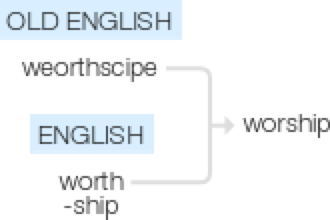
‘Worship’ then, in this sense, is to rightly appraise something’s value. Taken this way, we could, so to speak, give everything its ‘worth-ship’ or its due. This isn’t very helpful in understanding whether Catholics worship Mary in the modern sense of term though, because, as I just mentioned, our modern understanding of “worship” takes on different connotations than the ‘worth-ship’ of the past. We need to distinguish between worship owed to God versus ‘worth-ship’ in the technical sense owed to a person or thing of honor.
The qualitative gap between the God and creature is infinite, and so then should our worship of them be. To help with this distinction, the Church has traditionally understood two different kinds of worship: douleia and latreia (both Greek nouns). St. Augustine of Hippo (354-430 A.D.) is one of the if not the first to define this distinction when he writes:
But that service which is due to men, and in reference to which the apostle writes that servants must be subject to their own masters (1 Peter 2:18) whereas the service which is paid to God alone by worship, is always, or almost always, called latreia in the usage of those who wrote from the divine oracles. (City of God, X.1)
Thanks to St. Augustine, it is apparent that—at least since the age when the New Testament was being authored—latreia is used in the way we now recognize more properly as worship, while douleia is what we now recognize more properly as honor. Understanding this, we can see how, even in Biblical and classical times, not all honor or worship looked the same; the Biblical authors themselves knew this and authored Scripture in that way, hence the previous distinction that St. Augustine points out. Understanding our terms, then, let us ask again with more specificity: do Catholics give ‘latreia’ to Mary? Again, the answer is “no.” Lumen Gentium, one of the principal documents of the Second Vatican Council, says as much:
Placed by the grace of God, as God’s Mother, next to her Son, and exalted above all angels and men, Mary intervened in the mysteries of Christ and is justly honored by a special cult [devotion] in the Church. Clearly from earliest times the Blessed Virgin is honored under the title of Mother of God… This cult, as it always existed, although it is altogether singular, differs essentially from the cult of adoration which is offered to the Incarnate Word, as well to the Father and the Holy Spirit, and it is most favorable to it. (Lumen Gentium, IV. 66)
Though the passage speaks most highly of Mary, as “exalted above all angels and men,” I want to emphasize the last sentence: “…it [Marian devotion] is altogether singular…” in that it “…differs essentially from the cult of adoration which is offered to the Incarnate Word, as well to the Father and the Holy Spirit…” Despite the high regard the Catholic Church may hold Mary in, it nevertheless does not give her even the same kind of worship to just a different degree, that it gives God; the very essence of the worship differs, as do the two objects of the worship. This is exemplified in the term hyperdulia—a portmanteau of the Greek huper (above) and the aforementioned douleia. This term, hyperdulia, is illustrative of both the proper kind and degree of veneration that the Catholic Church gives to Mary. Of all things worthy of dulia, she is above them all. Hyperdulia, then, is only given to Mary, and in a like way latreia is only given to God. By definition (definition of the Catholic Church, I might add), Mary’s “cult” of devotion is firmly cemented within the context of douleia and not latreia. Nevertheless, she dulia before all else by virtue of her being “blessed among women” (Luke 1:42).
 (Work in Progress)
Leave a comment